The Brain Switch: Understanding Somatic Stretching for Deep Muscle Release
At a Glance
Click a point below to jump to the details.Illustration: Studio PantsAnts™ / AI
We navigate through a world full of constant stimuli. Sudden pressure or relational tensions are not just mental events.
Even when the mind feels it has found peace, the contracted muscles often fail to return to their original relaxed state.
This is the reality behind persistent shoulder knots or lower back aches that seem to have no clear cause.
The Origins of Somatic Stretching and The Discovery of Soma
Somatic stretching is rooted in the work of Thomas Hanna who developed a system known as Hanna Somatic Education in the nineteen seventies.
Hanna rediscovered the Ancient Greek word σῶμα (Soma) which refers to the living body as experienced from within.
His core insight was that healing comes from focusing on the subjective body you feel and control from the inside rather than the body as an object observed by others.
This is a process of neuromuscular re-education where the brain and nervous system relearn how to control the body.
The Science of Sensory Motor Amnesia
Consequently, the brain forgets how to send a relaxation signal. This creates a feedback loop where your mind perceives relaxation, but your muscles remain stuck in a state of chronic tension.
Loss of Voluntary Control
The motor cortex loses its ability to fully communicate with specific muscle groups.
Energy Drain
Muscles that never rest lead to chronic fatigue and localized pain.
Perceptual Blind Spots
You become unaware of your own misalignment because the brain perceives chronic tension as a normal state.
The Three Core Principles of Somatics
The Application of Pandiculation
Inspired by how animals yawn and stretch, pandiculation is the heart of somatics. Instead of pulling a muscle long you consciously contract it slightly and then release it with extreme slowness. This allows the brain to remap the length of the muscle.
The Necessity of Slowness
The nervous system cannot learn new pathways through speed. It is generally recommended to move at a pace of about 0.4 inches (1 centimeter) per second. This slowness is what stimulates the sensory cortex to break old patterns.
Minimum Effort
Force creates more tension by triggering the body's defense mechanisms. Use only about twenty percent of your maximum strength. If you feel pain you, it is best to reduce your range of motion immediately.
Detailed Somatic Rituals for Common Tension
1. The Back Release: Reclaiming Spinal Freedom
Most back pain stems from a nervous system that has forgotten how to let go of the muscles along your spine.
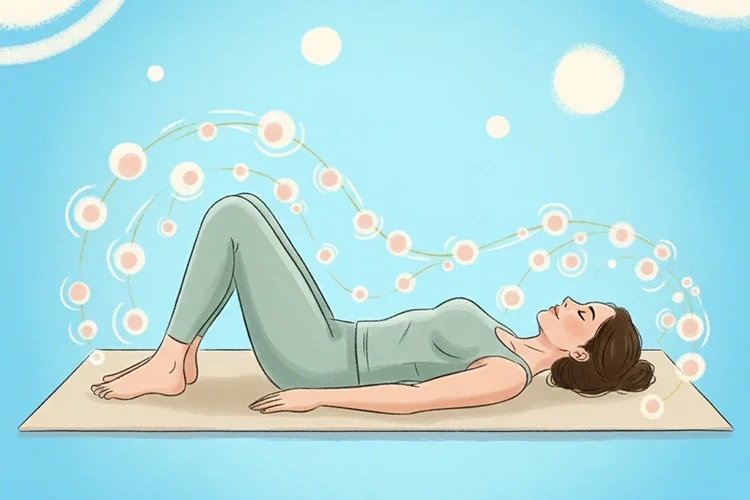
The Flow: Lie on your back on a flat, firm surface with your knees bent and feet flat. As you take a gentle breath in, slowly arch your lower back away from the floor. Feel the muscles in your back engage and shorten.
Then, as you exhale, take a full ten seconds to slowly lower your back, feeling each vertebra melt until your spine rests completely flat against the ground. Pause for a moment to feel the newfound space in your back.
2. The Side Bend: Opening the Breath
This movement gently releases the side waist muscles (obliques) and shoulders, allowing for a deeper, more expansive breath.
The Flow: Lie on your right side with your knees slightly bent, using your right arm as a cushion. Place your left arm over your head. Slowly bring your left shoulder and hip closer together, contracting the muscles on your left side.
Once you feel a gentle engagement, begin to release very slowly. Imagine your muscles lengthening fiber by fiber, returning to the starting position with minute, controlled movements until you feel completely heavy and relaxed.
FAQs: You May Ask Before Starting Your Somatic Ritual
-
Small tremors or jumps during very slow movement are a positive sign that your neural pathways are reactivating.
It indicates that your brain is reestablishing voluntary control over muscles that were previously neglected or held in tension.
-
Somatics is not about mechanical flexibility but rather a process of neuromuscular re education.
In fact those who feel the most stiff often see the quickest results because their muscles are simply stuck in a state of high contraction that the brain can learn to release.
-
Since the brain learns through repetition, daily practice can be highly beneficial.
Spending just ten minutes a day focusing on your internal sensations will strengthen the communication between your brain and muscles allowing you to break free from chronic tension much faster.
A Time to Listen to Your Body
Somatic stretching is not about performing movements with a fixed correct answer. It is an exploration where you focus on the subtle signals sent by your body to reclaim the sense of relaxation you may have forgotten.
Change begins simply by observing your current state rather than trying to force your body to change. I invite you to take ten minutes tonight to engage in a quiet dialogue with your own Soma.
Sources & References
- [1] Johns Hopkins Medicine (2024). "Somatic Self-Care: Connection and Support." Office of Well-Being.
- [2] Somatic Movement Center (2025). "Clinical Somatics: Sensory Motor Amnesia and the Science of Pandiculation." Somatics Learning Library.
- [3] Harvard Health Publishing (2023). "What is somatic therapy?" Harvard Medical School.
Read Next