Is Your Phone Quietly Aging You? A No-Nonsense Guide to Indoor Sun Protection
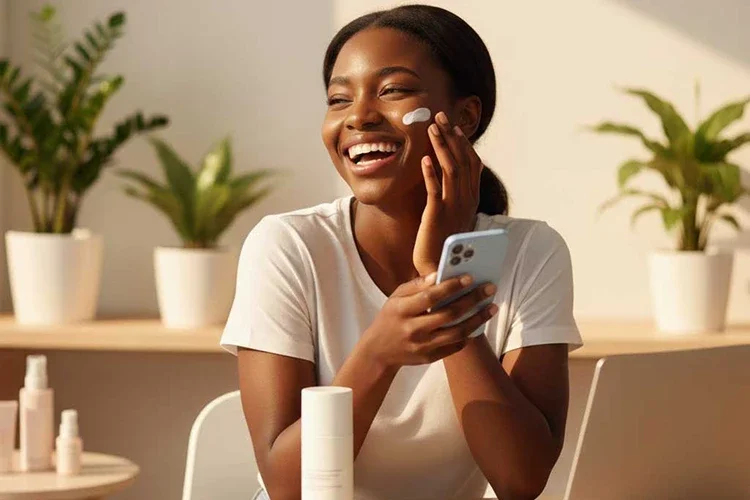
The essential daily shield against indoor UV and blue light. (Image: AI-generated)
Even the most devoted skincare shoppers tend to assume that staying indoors gives their skin a break. It doesn't.
It's simply a different kind of exposure. Sitting by a sunlit window and scrolling through your phone in bed at midnight ask different things of your skin barrier, but neither is neutral. Layering on serums while ignoring either one is a bit like redecorating a room with the ceiling leaking — the intention is right, the order of operations isn't.
Two aggressors tend to go unnoticed indoors. UVA rays move through standard window glass with very little resistance, and the high-energy visible light emitted by your screens, more commonly known as blue light, works on skin in its own, less straightforward way. Both deserve a closer look.
Windows Are Not Shields: The UVA Invasion
Sunlight carries two main players — UVA and UVB. UVB is responsible for sunburn, and ordinary window glass does a reasonably good job of keeping it out. UVA is a different matter entirely.
It's sometimes called the "aging ray" for good reason. It passes through glass largely unimpeded and reaches deep into the dermis, where it works quietly beneath the surface, thinning the collagen architecture your skin depends on for resilience.
If your room is bright enough to read comfortably, your skin is already on the receiving end. It's one of the more underestimated stressors in a daily routine, precisely because there's no burn, no redness, no obvious signal to act on. The damage accumulates quietly, and by the time it's visible, it's already been years in the making.
The Blue Light Question
Blue light deserves a more honest conversation than it usually gets in skincare marketing. It's true that it sits at a longer wavelength than UV, which in principle allows it to travel deeper into tissue.
Where the marketing tends to overreach is the comparison to your actual phone. The light doses used in these studies are considerably more concentrated than anything a smartphone or laptop emits at arm's length. That doesn't make screen exposure irrelevant — hours spent inches from a glowing panel, day after day, add up in ways a single lab session doesn't capture — but it does mean the "your phone is sunburning your face" framing is more editorial flourish than clinical fact. What we can say with more confidence is that chronic, low-grade light exposure, blue light included, keeps skin in a mild state of oxidative stress rather than letting it settle into its usual overnight recovery. Over time, that shows up as dullness and uneven tone rather than anything more dramatic.
What Kind of Protection Do You Need Indoors?
Clear, everyday sunscreens were formulated with UV in mind, not visible light. If your day is largely spent in front of a screen, these three ingredients are worth knowing.
1. Iron Oxides
These mineral pigments do more than lend tinted SPFs their signature warmth. They're quietly one of the more sophisticated tools in modern photoprotection, acting as a physical filter that reflects visible light off the skin's surface before it has a chance to penetrate.
If pigmentation runs in your family or shows up easily on your skin, switching from a clear formula to a tinted one is a small change that tends to earn its keep.
2. Mineral Filters
Zinc Oxide and Titanium Dioxide cover a broader stretch of the visible spectrum than most chemical filters. Most people never think to ask which filter type is actually in their sunscreen — it's a fair question to start asking.
3. Antioxidants
Layering a Vitamin C, Vitamin E, or Niacinamide serum underneath your SPF gives your skin a second line of defense, neutralizing oxidative stress that manages to slip past the filter itself. Consider it a backup plan rather than a substitute for SPF.
A Note on Skin Types & Safety
High-performance protection only works as well as the cleansing habits behind it. Before adjusting anything in your routine, here's what's worth knowing for your skin type.
For Acne-Prone & Oily Skin
Tinted formulas with Iron Oxides and mineral filters tend to sit heavier than clear ones. Without a proper cleanse at the end of the day — ideally a double cleanse — those particles can settle into pores and contribute to breakouts. "Non-comedogenic" on the label is reassuring, though it's not an ironclad guarantee.
For Sensitive Skin
Mineral filters generally sit more gently on reactive skin than chemical alternatives. Layering them over potent actives like Vitamin C or Retinol can occasionally cause mild tingling. If that happens, splitting the routine — antioxidant serum in the morning, SPF applied on its own later — tends to smooth things out.
Who Should Patch-Test First
Anyone with highly reactive skin, or an active inflammatory condition like severe rosacea, should test a small area before committing. The same pigments that make Iron Oxides effective against blue light can, in rare cases, irritate an already-compromised barrier.
Indoor Protection FAQs
-
If the room is bright enough to see clearly, the answer is yes. UVA doesn't require a direct line of sight — it scatters around a room and still reaches your skin. Unless you're in a windowless space or behind blackout curtains, that exposure is accumulating quietly in the background.
-
No. Those filters were designed to ease eye strain, not to protect skin. Blocking the effects of visible light on skin calls for a physical filter like Iron Oxides, most commonly found in tinted sunscreens.
Expert photoprotection guidelines specifically recommend broader-spectrum coverage, including visible-light protection, for individuals whose skin is prone to pigmentation.[4]
Your screen filter looks after your eyes. Your SPF looks after your face.
-
Not quite. Most clear, chemical sunscreens were built to manage UV, not visible light. If digital exposure is a genuine concern for you, mineral filters — and Iron Oxides especially — are the ones to look for. [3]
A tinted formula acts as a physical layer that reflects light away rather than simply absorbing it.
The Invisible Habit Worth Noticing
The expensive part of skincare gets most of the attention, but the quiet, unglamorous habits — the ones with no audience — are usually what actually move the needle. You don't necessarily need a new serum. You need a clearer sense of how bright your room gets in the morning, and how many hours your face spends a few inches from a glowing screen. Those are worth sitting with before the next purchase.
The light will always find its way into the room. A tinted SPF simply decides what happens next, in its own small and deliberate act of skin architecture.
Sources & References
- [1] Bernerd, F., et al. (2022) "Effects of Blue Light on Skin: Past, Present, and Future" International Journal of Molecular Sciences (IJMS)
- [2] Mahmoud, B. H., et al. (2010) "Impact of Long-Wavelength UVA and Visible Light on Melanocompetent Skin" Journal of Investigative Dermatology (JID)
- [3] Dumbuya, H., et al. (2020) "Impact of Iron Oxide-Containing Formulations Against Visible Light-Induced Skin Pigmentation" Journal of Drugs in Dermatology (JDD)
- [4] Passeron, T., et al. (2021) "Photoprotection according to skin phototype and dermatoses: practical recommendations from an expert panel" Journal of the European Academy of Dermatology and Venereology (JEADV)
Read Next