How to Choose Professional-Grade Adjustable Dumbbells
At a Glance
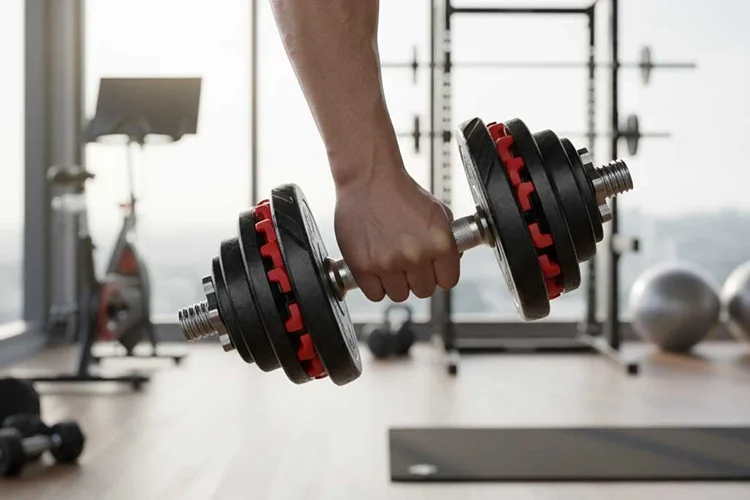
Click a point below to jump to the details.Consider using adjustable dumbbells with clear standards to minimize instability and injury risk. (Image: AI-generated)
For the high-achieving professional, the home gym is an essential hub for efficiency.
Adjustable dumbbells sit at the center of this setup, offering the versatility of a full rack within a compact footprint.
However, if you treat your body like a finely tuned machine, you must evaluate these tools with a critical eye.
The difference between a consumer-grade toy and a professional-grade tool lies in the engineering. Poorly made gear doesn't just feel cheap; it disrupts your natural movement and increases the risk of chronic strain.
The Hidden Danger of Unwanted Rattling or Wobbling
Most buyers focus on the maximum weight capacity, but the real metric of quality is the "play" or rattling, which refers to the unwanted movement between the weight plates.
When you perform a movement with a rattling dumbbell, the weight pulls in different directions unpredictably.
Choosing equipment with a "single-piece" feel ensures that your energy is directed toward the lift rather than stabilizing a faulty tool. Precision in hardware leads to precision in movement.
Performance vs. Consumer Grade
Understanding the materials inside your gear is the only way to ensure a high return on investment.
| Key Specification | Consumer Grade | Performance Grade |
|---|---|---|
| Internal Mechanism | Composite Plastics and Resin | High-Tensile Steel and Industrial Nylon |
| Structural Stability | Noticeable rattle and plate shifting | Zero-gap integration for a solid feel |
| Handle Engineering | Smooth rubber or shallow stamping | Precision-machined metal knurling |
| Weight Increments | Large jumps of 4kg or more | Granular adjustments around 2kg |
A 3-Point Checklist
Before integrating a new pair of dumbbells into your routine, put them through this technical audit to ensure they meet professional standards.
Plate Alignment and Integrity
When the dumbbells are removed from their cradle, all plates should stay perfectly straight and aligned to the handle. If you can feel the plates shifting during a bicep curl or a press, the locking mechanism lacks the necessary precision fit. This loose movement is a distraction that limits your maximum output.
Heavy-duty Steel Locking Systems
The safety of your gear depends on the components that hold the weights in place. Avoid models that rely heavily on plastic latches. Over time, friction and impact cause plastic to become brittle and crack, leading to potential plate failure during overhead movements. Always opt for steel ratchets or high-density interlocking connectors.
Knurling and Tactile Response
The texture of the handle, known as knurling, is your primary interface with the weight. High-quality gear features a diamond-patterned metal surface that provides a secure grip even when your hands are wet with sweat.
FAQs: Real-World Performance
-
No. These are precision-engineered tools with internal locking pins and gears.
You drop them, you damage the internal locking parts, and suddenly you have a rattling paperweight. Think of it as a discipline check—controlling the weight all the way to the floor is part of the rep.
-
Some "play" is necessary for the plates to engage, but excessive rattling is a sign of a loose fit. It doesn't always mean it'll break tomorrow, but it erodes your focus.
You shouldn't be wondering if a plate will fall on your face during an overhead press. If it sounds like a bag of bolts, the locking mechanism is low-spec.
Look for a "tight" build—silence is a sign of good engineering.
-
It’s the only move that makes sense. Buying 10 pairs of fixed dumbbells is a logistical nightmare and a waste of floor space. One pair of high-quality adjustables gives you a full rack's worth of utility in the footprint of a shoebox.
Space is premium real estate. Efficiency is key. Spend once, buy the right hardware, and focus on the work, not on where you're going to store 400 lbs (180kg) of scattered iron.
The Science of Steady Muscle Growth
To achieve consistent growth, you must apply the principle of progressive overload. Equipment that only allows for massive jumps in weight forces you to either stall or take unnecessary risks.
Gear that offers smaller, granular increments allows you to fine-tune the resistance to match your body’s steady progress.
In the end, your adjustable dumbbells are more than just weights; they are the hardware that powers your physical evolution.
By looking past the branding and focusing on mechanical stability and material durability, you ensure your equipment is as resilient as the body you are building.
Sources & References
- [1] Kohler, J. M., et al. (2010). "Muscle activation patterns while lifting stable and unstable loads on stable and unstable surfaces." Journal of Strength and Conditioning Research. (PMID: 20072068)
- [2] Edgren, C. S., et al. (2004). "Grip force vectors for varying handle diameters and hand sizes." Human Factors: The Journal of the Human Factors and Ergonomics Society. (PMID: 15359674)
- [3] Peterson, M. D., et al. (2004). "Maximizing strength development in athletes: a meta-analysis to determine the dose-response relationship." Journal of Strength and Conditioning Research. (PMID: 15142003)
Read Next